It all began innocently enough and after only a few days, ended with 458,500 people reached, inquiries from government agencies, worried hikers and a large number of very amused people.
As I had many times before, I recently posted what I thought was an entertaining and obviously made-up post on one of my Facebook pages, World Trails Foundation. If you visit the WTF site on Facebook, you’ll see what I’m talking about. Admittedly, and in all modesty, I have to say that the photo is one of my better efforts. In addition to disclaimers on the page indicating that WTF is a fictional organization, etc. I wrote into the photo description (below) some lines that I was sure would reveal that this was all in fun. Over a period of just a few days, it turns out that a LOT of people didn’t bother to read the caption, much less investigate the World Trails Foundation. The post was shared widely and took off like wildfire. The numbers of people reached exploded exponentially while my wife and I looked on in awe. Eventually, the U.S. Forest Service in the Portland Regional Office and the Okanogan Wenatchee Forest Supervisor’s Office were fielding inquiries from a worried public, a prominent news outlet and from other agencies with field-going personnel in the region.
Just as quickly, if not more quickly, than it took off, interest and concern over the post evaporated like last night’s rain in the morning sun. Word finally got out that the story wasn’t real. I think much of the credit for that goes to the many observant readers who left very funny comments on the post, some of them humorously critical of those who believed the story.
My co-workers were vastly amused over it all and my wife and I were left shaking our heads over the strangeness of what happened. WTF gained a lot of readers though, and that’s not a bad thing. And I gained greater insights into how modern society processes information. It’s rather frightening and explains a lot about what’s going on in the political arena these days.
As a postscript, Snopes.com got into the act and declared the tiger story false. Well duh!
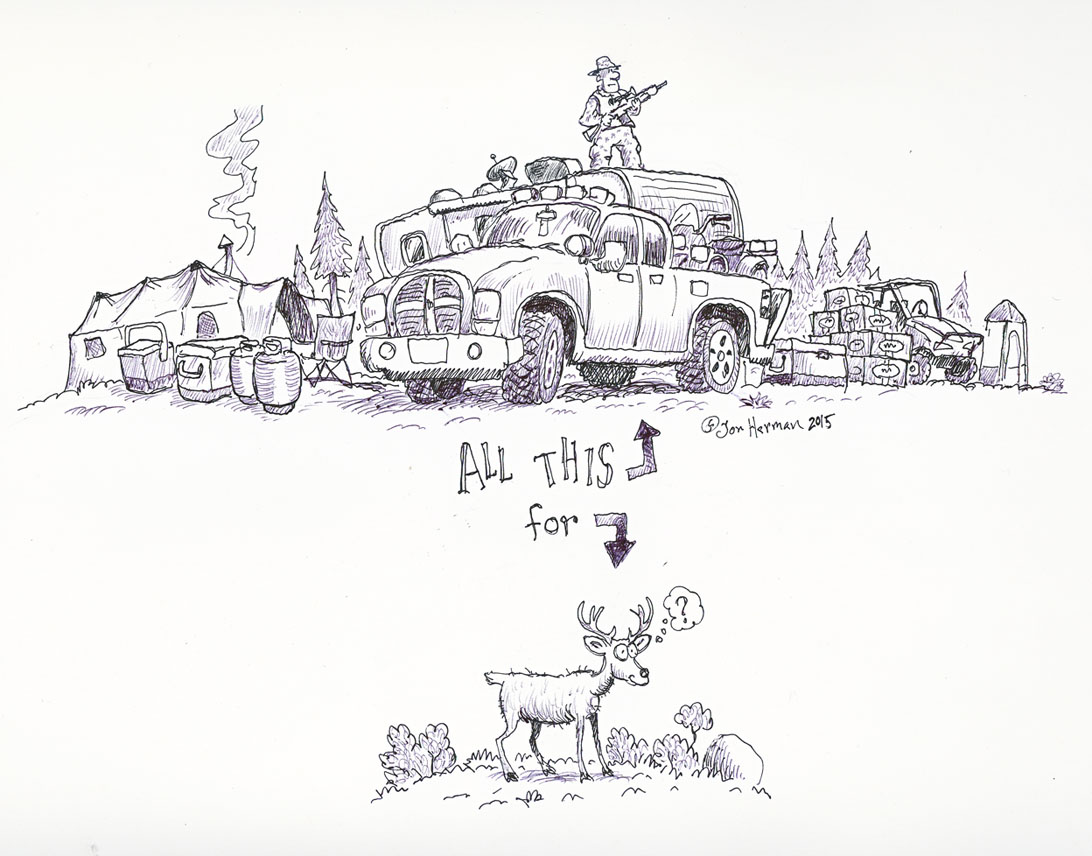
It’s here again. Fall is a wonderful time to hike in the mountains and forests, but be careful! Deer season has opened and the hills are alive with the sound of motors and people in motion, along with the occasional gunshot. Elaborate hunting camps have sprung up everywhere there’s a road and a campsite. Huge pickups, massive trailers and RV’s, ATV’s, side-by-sides, generators, giant Cabelas multi-room tents, toilet chairs and buckets, etc. This stuff has been rolling into the forest the last few days. Seems like a lot of materials, energy, time and effort just to get a little buck! Gone are the days of the hunters in the battered old pickup, camping in a Coleman tent with a two-burner white gas Coleman stove, dressed in red plaid Filson coats, toting a lever-action .30-.30 Winchester, and maybe only one case of beer and a whiskey flask in camp. Now some of the hunters look like Navy Seals wannabes, with gun slings and AR-15’s, giant scopes, range-finder binoculars, night vision goggles, Go-Pros, game cameras, total camo outfits, face paint, etc. It’s all very strange and discordant.
Local nature; the little natural treasures that can be found in and around our towns and neighborhoods. From a line of trees planted for a wind break along a rural road to a vacant lot with a small, sparkling creek flowing through it to an abandoned pasture rich in high grass to an old rail line converted to trail. There’s a lot of it around here, but it’s vanishing at an accelerating rate. Since that vanishing is often taking place on private land, there’s not much we can do about it except note its benefits to the community and its inevitable passing as it succumbs to the saw, bulldozer and encroaching population.
Every day sees a loss of our local nature, from windmills now marring some of the best scenery in the state to the felling of trees and building of mega-homes on forested lots to the construction of retail stores on pasture land in the Kittitas Valley. Every time a mature tree falls, it will be 60-100 years before a new one can replace it, and most of the time when trees are cut down, it’s because something man-made is replacing it, whether it be a home or a new store or restaurant.
We’re told that in order for our local economy to be healthy it must keep growing, so we need more stores, more gas stations, more motels, more fast food joints, more latte stands, more roads, more homes, more tourists, more residents. All of this “more” should naturally make us wonder if there is any limit or will we be “mored” right into being the overcrowded, over-busy maze that many west side towns and cities have become. So trees keep falling, pastures keep getting buried under fill and flagged stakes appear in fields to mark their imminent disappearance. Along with the landscape, those who live in it disappear too, or adapt and are called pests. Raccoons, porcupines, deer, bears, bobcats, coyotes, curlews, hawks, skunks, snakes, lizards, frogs, etc.. More local nature lost. And then there’s the local human residents, who find themselves financially unable to continue living in their own homes due to increasing property taxes and other fees brought about by increases in property values brought about by development. Gentrification is a whole other subject, though it often accompanies the destruction of local nature.
Treasure those little natural bits that linger in our communities. Treasure and enjoy them and hope they stay a little longer.
This is my hard-boiled narrative of the cartooning process:
ANATOMY OF A CARTOON
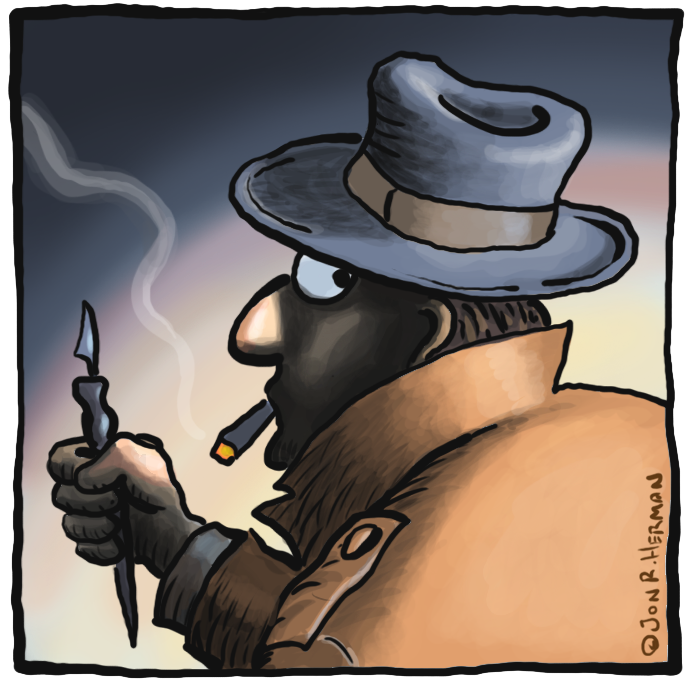
She was the first client to walk through my door in weeks. I was caught by surprise with my feet on the desk and my head in the clouds, gathering wool. She paused by the door, tall and blonde and dressed to the hilt. Her cool stare took it all in; a half-empty bottle of beer on the blotter, the scattered dirty ink pens next to a sloppy heap of old sketches, the darts stuck in the wall, the unpaid bills. I could tell she was a classy dame and she wasn’t impressed with what she saw. I could also tell she was nervous and desperate. Most important of all, I could tell she had money. Yeah, dames like her wouldn’t even look at a cartoonist when things were goin’ good, but when they suddenly needed help, they pinched their noses and gritted their teeth and sneaked into my office like a nun into a bar.
“I need some cartoons and I need them quick,” she blurted out after some hesitation. I asked her what she wanted done and she told me. As I sat there figuring what it would take in time and materials to do the job, she wandered around the small room, glancing out the window now and then, nervous as a coyote at a sheepherders’ convention.
Her’s was a pretty straightforward job and in no time I quoted her a price. She laughed scornfully. “That much money for four cartoons? Are you out of your mind? I can’t believe you’d charge me this much for…for…for a bunch of simple cartoons! Why, it wouldn’t take you more than half an hour to sit down and do these!”
I sighed and leaned back in the rickety wooden chair, gave her my best tough cartoonist stare and told her in a flat voice, “Lady, you don’t know jack about this line of work. You think it’s all about just grabbin’ a pen and sittin’ down to have a good time, don’t you? You think I’m just some kind of miracle worker that can solve your problem quick and easy? It don’t work like that. There’s no rules in this racket; every new cartoon is a gut-wrenching challenge. You better sit down and listen hard while I explain some simple facts about cartooning…”
* * * *
GET THE IDEA?
Before a cartoon can be done, it has to start with an idea, and getting the idea can be the most difficult, time-consuming, challenging and sometimes enjoyable part of the whole process. To make this easy, let’s follow a simple single-panel cartoon from start to finish. This process applies to other types of cartoons also, such as comic strips, editorial cartoons, greeting cards, and comic books. It gets much more elaborate when a story line is involved, so we’ll stick to the simple single-panel type of cartoon.
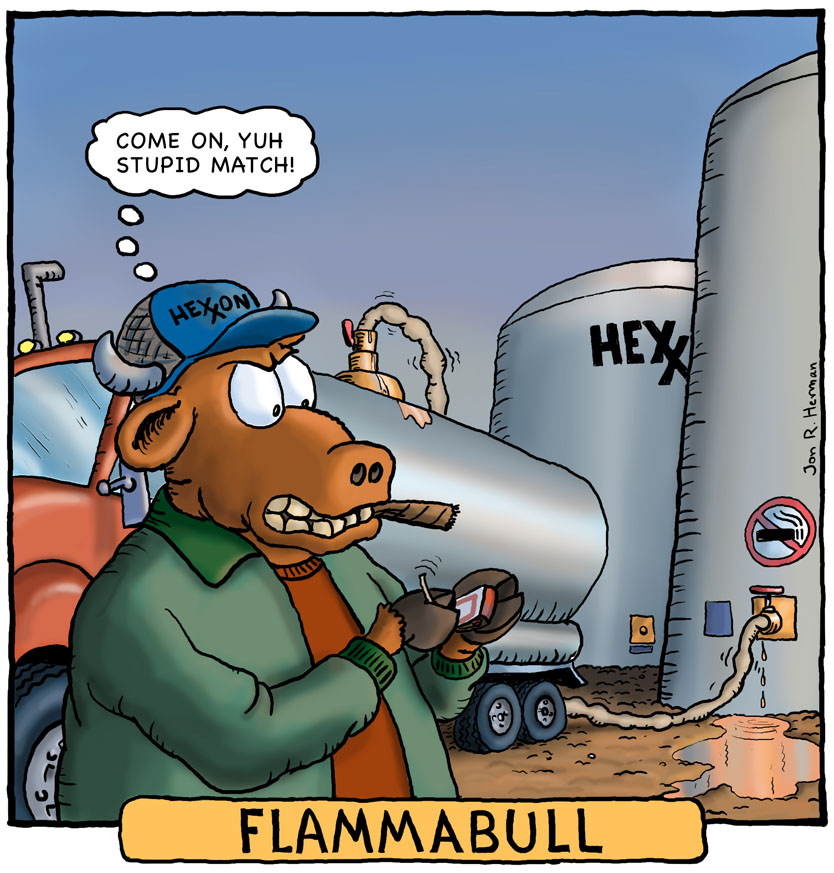
There are a few rare occasions when the right idea just pops into my head, but most of the time the idea is the result of a lengthy evolutionary process of day-dreaming, free association and doodling in a sketchbook. For the sample cartoon, part of the “Bulltoon” series, I first came up with an appropriate word that would be a pun based on the word “bull”. From a long list of such words, I picked the word “flammable” because it had a lot of possibilities. With that word in mind, I started to consider different ideas, sketching the better ones as they appeared. Eventually, I came up with a situation where a bull might be “Flammabull”, including the elements of gasoline, an open flame and a moment of extreme stupidity. MAKING A SCENE:
A cartoonist is like a combination of screenwriter, cinematographer and movie director. He or she has to come up with the setting, lighting, angle of view, props, and characters. The characters have to be placed in the right spot with the appropriate clothing and facial expressions, gestures and body language. And then there’s dialog; it has to be concise, funny and work with the drawing.
For “Flammabull”, I decided to depict the bull as a fuel truck driver filling his truck at a refinery. To draw the setting, I needed reference pictures of a fuel truck and refinery storage tanks. Although cartoon drawings can be pretty basic, a certain level of accuracy is still important. Research into how real-world objects look and work is vital to being able to draw a cartoon version that is instantly recognizable to viewers. In addition to using pictures, it’s often good to get out and sketch actual objects, people, animals, etc. I don’t do this much, which is why I usually have to spend a lot of time trying to find a picture to work from.
After a lengthy search, I found what I needed in my computer’s picture archives; a large, unorganized file of digital photos and graphics. More frequently, I use a search engine to access the images of choice. With the pictoral information in hand, it was time to work on the rough drafts of the cartoons. WHEN THE GOING GETS ROUGH:
The basic composition, character expression and dialog are done in one or more small (usually about 1.5″ by 2.5″) pencil sketches in a sketchbook or on a piece of 8.5 x 11″ typing paper. For “Flammabull”, I did two sketches. In the first one, I didn’t like the composition or the dialog, so I did another sketch with a slightly different composition and new dialog. The bull character had to have a short one-liner that would fit the situation. After some brain storming, I finally came up with one I liked. The bull calling the match “stupid” seemed appropriately ironic in this situation.
The next step was to do a full-sized rough in pencil. This can be done on a piece of typing paper and then traced onto the final draft for inking, or done on the final draft itself. For “Flammabull”, I did it on a separate piece of 8.5″x11″ typing paper. In the composition, the bull character was moved and enlarged to make it more prominent. One of the pitfalls of cartooning is getting fixated on the background elements. Sometimes they’re so much fun to draw that the cartoonist lets them overwhelm the characters. Once I had a rough drawing that worked, it was time to do the finished product. MAKING THE FINAL DRAFT
Now comes the fun part; everything comes together and I actually get to draw something in ink. I traced the basic “Flammabull” sketch onto a 8.5″x11″ page of copy paper (I use this size for ease of transporting, copying and filing). It’s usually better to draw the final draft on a sheet of smooth-surfaced bristol board (a cross between paper and cardboard) because of its strength and durability, but it saved me a lot of time to draw the cartoon on a page with the logo and border already there. That way I didn’t have to redraw those or cut and paste them onto the cartoon.
A variety of implements could’ve been used to do the final drawing and shading, including watercolor brushes, pencils, felt pens, rapidograph-type fountain pens, ball point pens and/or pen points dipped in black India ink. For the first version of “Flammabull”, I used three rapidograph pens with different point widths and a black felt pen (waterproof) with both fine and broad tips. The latter is handy for filling in large black areas or making extra thick lines. For the version shown here, I scanned the ink sketch into Photoshop, made some changes and went on to do the coloring, utilizing layers.
The finished product!
The drawing took about 45 minutes to do. The Photoshop coloring took about an hour and a half. The average time to do a cartoon is two to four hours. It can take longer sometimes because the final draft just doesn’t turn out right and I have to do it over. When the drawing (the initial non-digital version) was done, I took it to a local bookstore, made five high-quality copies and delivered a copy to the local weekly newspaper for publication. The original and other copies went into a file cabinet and I went to the easy chair to recover from all the hard work.
* * * *
“…and that’s what it’s all about, doll,” I concluded as I stood at the window, looking out at nothing with a thousand-yard stare, remembering what doing that Bulltoon had been like. What it had cost in ink, sweat and paper cuts. “Sure, it’s a tough way to make a living, but somebody has to do it. Look, I ain’t no hero. I just do my job. I just wanted you to know that it ain’t as easy as it looks, that I’ll earn your dough. So what d’you think? Miss?”
She didn’t answer. She was probably too impressed for words. I turned around to look at her; maybe find some kind of clue on her face. There was a clue there, alright. I could’ve read her face like an open book if her eyes hadn’t been closed. She was snoring softly. I was glad to see that she’d relaxed and felt comfortable. She seemed a little embarrassed when I woke her up; said she had a better understanding of the work she wanted done. I gave her a written estimate and she promised to get back to me. I didn’t push it. In this line of work, people have to decide for themselves. As I watched her walk down the dim hallway to the elevator, I hoped that she’d be back. I needed the work more than I needed the money. Hey, I’m a cartoonist. It’s who I am. It’s what I do.
Epilogue: This was written some time ago and the process has changed a bit. Most of my cartooning is done digitally now, with even rough drafts done in layers in Photoshop. Sometimes I miss the old process, but when it comes to coloring and inking, Photoshop and Corel Painter have some amazing advantages.
There are new safety sessions at work labeled as “Stand Down for Safety”. The phrase “stand down” has baffled me since the first time I heard it. Stand down? What? How the hell do you stand down? You either stand up or you sit down. You can’t stand down even though you can sit up. People who use that phrase weaken their credibility by asking the impossible.
Sure, I’d love to do something for safety, but I’m afraid I can’t help when it comes to “standing down” because, you see, it’s f***ing impossible!! And frankly it doesn’t sound safe. Standing down sounds a little like falling down because in order to fall down, you usually have to be standing up, so you start out standing, but then you fall down. That’s the only way you can stand down and that could lead to injuries. I will gladly sit down for safety, or pause for safety, or stand up for safety, or even lie down and take a nap for safety, but I honestly can’t stand down for it.
Maybe I’m being too literal, but I can’t understand using phrases that contain within themselves the seeds of their own impossibility. So I’m going to leave this issue behind now, pull myself up by my own bootstraps, give the effort 110%, get that done yesterday and do more with less. I’m totally down with that, but I’m sitting, not standing.
I’ve been meaning to write about this for some time. Down in lower Kittitas County, in almost every direction you look there are windmills. Watching the giant white wind towers go up like a fence around the Kittitas Valley has been disconcerting, to say the least. I used to rant about every cell tower that went up on some prominent location and then got used to that visual insult. Now there are hundreds of wind towers everywhere and I’m boggled by the visually intrusive monstrosities every time I journey east. They are everywhere now, reminding me of the Martian machines striding across the landscape in “War of the Worlds”.
In fact I don’t have to go east, really. On a clear day and with low power bincoculars, the towers can be seen from the crest of the Cascade Mountains.
One of the things I used to love about Kittitas County was the sweeping vistas of prairie and sky, mountains and clouds. The feeling of wildness. Now there’s this visual white picket fence being built around us so that we can no longer enjoy clear views. Some would say that scenery takes second place to energy needs. In this case, the energy is going to California, so we in essence become a subservient energy factory for the folks down south.
The windmills are, to my mind, another emblem of the Technisocial Wave washing back at us from the West Coast, filling the valleys and capping the ridges with homes, roads, traffic, mechanical and electronic incrustations, wiping out more of the local nature that many long-term residents value. Local nature is being whittled away…no, rather it’s being hacked away, piece by piece. We have been discovered here, and a flag claiming ownership has been planted. A flag with dollar signs on it.
Windmill farms, housing tracts, resorts, golf courses, multi-million dollar homes, new roads, bigger freeways, more traffic…is this what we want here? And even if it isn’t, is there anything we can do about it? It doesn’t seem that there is. This relentless wave will probably continue until our once beautiful and peaceful county is converted to the type of place that people moved here to get away from. I know that sounds pessimistic, but all my life I’ve watched this process occurring almost everywhere and seen how little our culture as a whole values the things that it destroys.
I was inspired to write about multitasking after reading Matt Richtel’s series in the New York Times, “Driven to Distraction”. His articles point out the pitfalls of drivers trying to multitask and the dangers involved in doing that. He’s also written about the entire array of electronic, digital devices that now seduce us away from awareness of our surroundings. I was relieved to read about this because it validates my own doubts and concerns about our current culture of distraction and multitasking.
I’ve always defined multitasking as “many things done, but few things done well”. That sums it up for me because I’m lousy at multitasking and find that the increasing demands for it in the workplace are irritating as hell.
Multitasking leaves little room for craftsmanship, or satisfaction. It’s life and work on the run. Get this done, get that done, get this and that done at the same time while unconsciously dropping the ball somewhere else. Loose ends wave around like Medusa’s snaky hair, demanding attention here and there and everywhere, threatening to bite when you least expect it. It’s a crazy way to live, and to work, yet we find ourselves doing it anyway.
I wonder if we have to live that way or do we choose to? Who or what is demanding that we work and live this way? What would happen if you gave your full attention to something, did it and moved on to the next thing? Would there be fewer of those Medusa strands waving around? Would you get fired for not achieving a certain level of output despite increased quality of what you accomplished? I sure don’t know but I do know this, that if we don’t take a stand against this kind of mental abuse, it will just get worse. By accommodating it, we enable it and by enabling it, we perpetuate it.
As one who is mostly incapable of multitasking anyway, I find it easy to just say no. I really don’t have much choice in the matter since I’m so bad at it. But if you’re one of those people who is good at it, or think you’re good at it, it might be tougher. You are now expected to operate at that level and any lessening of that will be seen as backsliding. Good luck with that!
I guess the title says it all, but let me elaborate by saying that I don’t like so-called working lunches. They really don’t work for me. When it’s lunch time, it should be time to unwind, eat some food, shoot the breeze. You know…LUNCH TIME, as in time to take a break.
I don’t know about you, but I don’t get paid during lunch time, so am reluctant to continue working. Also, not being Superman, I tend to get tired and need a break in the middle of the day. Usually, I get that opportunity, but recently was at a workshop where the facilitator hosted a working lunch. If I’d had enough advance notice, I would’ve made plans to be elsewhere during lunch, but I was stuck there, working while I ate. Of course that’s not all bad, but lunchtime, or any meal time, should be a time for people to relax a little and read, or talk, or just sit and stare into space. There should be nothing wrong with staring into space; it’s the final frontier and I think we all feel a little wistful about that.
It says something about our culture that lunch time is regarded as yet another opportunity for “productivity”. What’s next, a working bowel movement? Oh wait, that’s already happened. A while back, I heard a guy in a public restroom talking work on his phone in a stall. Imagine the horrific background noise that the person on the other end had to endure. “Joe, was that our stock price tanking, or was that you? Where the hell are you anyway?” It could give “trickle down” a whole new meaning.
Back to the theme here. I just want to keep taking my lunch time as guaranteed in the Constitution (it has to be in there somewhere since the Founders probably had plenty of working lunches putting the Constitution together and thus got sick of them). It’s all a part of trying to slow this culture down a bit so that it doesn’t go completely nuts.
I just found out that it was National Poetry Month and am inspired to offer my own humble composition. Several years ago I set out to write the worst possible poem I could write at that time. I think I can do even worse now, but still like the following for its angst-ridden, brooding quality…
Dead Bird
Evening and golden sunlight,
I was walking down the beach.
(Or was it up?)
It matters not, thought I grandly as I meandered
Loquaciously,
Deep thoughts spiralling up,
(Or was it down?)
From my brain it mattered not the direction,
As they tumbled and mumbled from my mouth,
In a torrent of profundity,
To an unhearing and uncaring world,
Pearls before swine, I thought judiciously,
And age before beauty.
Then a bird,
Dead bird,
Dead bird dead,
Lay upon the tide-tortured sand at my feet.
An Icarus in reverse with wings laden black and oily,
From the dejecta of stored sunlight crude.
Tarred and feathered without the rail.
Dead bird,
Dead dead bird,
Lay upon the sand at my feet,
Ended thoughtflow as I stared in fascinated horror.
Grace and flight ended in disgrace and fright,
Filled me with dismay as waves,
Waves,
Rolled in unheeding, driven by the distant wind
And the moon,
Uncaring yellow orb above the eastern rim.
Dead bird.
Very dead bird.
Once source of beauty and now,
Now,
Miasmic wellspring of dark thoughts
On a bright shoreline.
Bird,
Dead bird,
Bad dead bird,
Damn bad dead bird,
God damn bad dead bird,
Ruined a fine walk on the beach.
The first autumnal snowfalls in the forest are magical events. The low deciduous perennials have dropped their leaves and stand skeletal above a carpet of fading color, tiny green buds visible on the branch tips of many species. The annuals have dispersed their seeds and withered, fading back into the forest mulch. With the summer leaves gone, a person can see far through the trees now.
Colors are muted, from the washed-out overcast sky to the tall, dark conifers. The forest is quiet and still, and there’s a feeling of sleepiness. There’s still some isolated activity though; ravens croak above the trees, here and there a squirrel scolds as it continues to gather food, far away a woodpecker hammers a hollow snag.
I’m describing a first snowfall that I observed up at Hyas Lake several years ago. It was late October or early November and the forest was as described above. Very quiet and peaceful. I was there with a co-worker, doing some final work on the Deception Pass Trail. We’d accomplished our mission and were heading back.
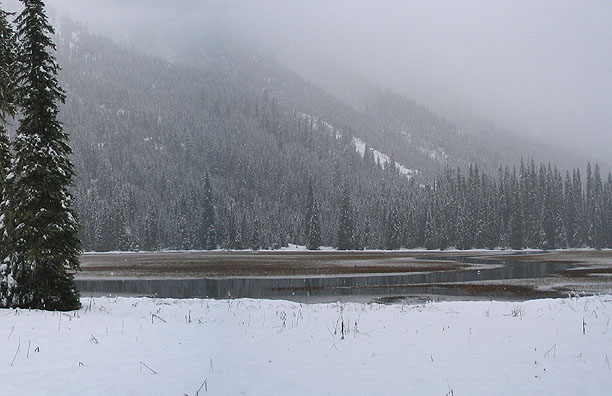
We stopped at Upper Hyas Lake and walked out into the golden lakeshore grass. The air was very still and the overcast had turned fuzzy and white and was sinking gently toward us, shrouding the peaks. We stood quietly beside the calm lake and watched the descending cloud. Soon a few lazy white flakes of snow swirled by, and then a few more.
The forested slopes above the lake faded slowly into white obscurity as the snow cloud grew thicker. Soon we couldn’t even see the far side of the lake and were surrounded by the whispering hiss of falling snowflakes.
As the snow thickened, we returned to the trail and continued the hike out. Walking along the lake shore, the ground in open areas was turning white. The snow grew heavier and the silence was filled with the faint hissing of colliding, falling, swirling, flakes. Millions of tiny ice-stars chipping and breaking.
We left the lake and walked into the thick forest. It had been autumn when we hiked in and now it was winter as we hiked out, the forest floor and trail covered in a couple of inches of smooth, silky snow. We found several fresh sets of coyote tracks and some deer tracks along the trail. The skeletal brush, fallen logs, boulders and drooping tree boughs were etched in white. I had the feeling that a blanket was being gently placed over the sleeping forest; protecting it through its long winter sleep.
By the time we reached the trailhead, there were over three inches of snow on the ground and it was still coming down. I was reluctant to leave. The storm was so quiet and peaceful it could barely be called a storm, even with the snow falling an inch an hour.
We did have to leave though, so we loaded our gear, got into the truck, closed the doors, turned up the heat and set the defroster to high, turned on the wipers to sweep away the snow and bumped off down the white road, encased in vehicle technology and insulated from the primal storm outside.


 J.R. Herman