The “Working Lunch” Sucks

I guess the title says it all, but let me elaborate by saying that I don’t like so-called working lunches. They really don’t work for me. When it’s lunch time, it should be time to unwind, eat some food, shoot the breeze. You know…LUNCH TIME, as in time to take a break.

I don’t know about you, but I don’t get paid during lunch time, so am reluctant to continue working. Also, not being Superman, I tend to get tired and need a break in the middle of the day. Usually, I get that opportunity, but recently was at a workshop where the facilitator hosted a working lunch. If I’d had enough advance notice, I would’ve made plans to be elsewhere during lunch, but I was stuck there, working while I ate. Of course that’s not all bad, but lunchtime, or any meal time, should be a time for people to relax a little and read, or talk, or just sit and stare into space. There should be nothing wrong with staring into space; it’s the final frontier and I think we all feel a little wistful about that.

It says something about our culture that lunch time is regarded as yet another opportunity for “productivity”. What’s next, a working bowel movement? Oh wait, that’s already happened. A while back, I heard a guy in a public restroom talking work on his phone in a stall. Imagine the horrific background noise that the person on the other end had to endure. “Joe, was that our stock price tanking, or was that you? Where the hell are you anyway?” It could give “trickle down” a whole new meaning.

Back to the theme here.  I just want to keep taking my lunch time as guaranteed in the Constitution (it has to be in there somewhere since the Founders probably had plenty of working lunches putting the Constitution together and thus got sick of them). It’s all a part of trying to slow this culture down a bit so that it doesn’t go completely nuts.

National Poetry Month; My Really Bad Offering

I just found out that it was National Poetry Month and am inspired to offer my own humble composition. Several years ago I set out to write the worst possible poem I could write at that time. I think I can do even worse now, but still like the following for its angst-ridden, brooding quality…

Dead Bird

Evening and golden sunlight,
I was walking down the beach.
(Or was it up?)

It matters not, thought I grandly as I meandered
Loquaciously,
Deep thoughts spiralling up,
(Or was it down?)

From my brain it mattered not the direction,
As they tumbled and mumbled from my mouth,
In a torrent of profundity,
To an unhearing and uncaring world,
Pearls before swine, I thought judiciously,
And age before beauty.

Then a bird,
Dead bird,
Dead bird dead,
Lay upon the tide-tortured sand at my feet.
An Icarus in reverse with wings laden black and oily,
From the dejecta of stored sunlight crude.
Tarred and feathered without the rail.

Dead bird,
Dead dead bird,
Lay upon the sand at my feet,
Ended thoughtflow as I stared in fascinated horror.
Grace and flight ended in disgrace and fright,
Filled me with dismay as waves,
Waves,
Rolled in unheeding, driven by the distant wind
And the moon,
Uncaring yellow orb above the eastern rim.

Dead bird.
Very dead bird.
Once source of beauty and now,
Now,
Miasmic wellspring of dark thoughts
On a bright shoreline.

Bird,
Dead bird,
Bad dead bird,
Damn bad dead bird,
God damn bad dead bird,
Ruined a fine walk on the beach.

© Jon Herman

Coming soon to this blog: Dead Elk; A Really Terrible Poem. For access to some good poetry, go to http://www.poets.org/

The First Snow

The first autumnal snowfalls in the forest are magical events. The low deciduous perennials have dropped their leaves and stand skeletal above a carpet of fading color, tiny green buds visible on the branch tips of many species. The annuals have dispersed their seeds and withered, fading back into the forest mulch. With the summer leaves gone, a person can see far through the trees now.

Colors are muted, from the washed-out overcast sky to the tall, dark conifers. The forest is quiet and still, and there’s a feeling of sleepiness. There’s still some isolated activity though; ravens croak above the trees, here and there a squirrel scolds as it continues to gather food, far away a woodpecker hammers a hollow snag.

I’m describing a first snowfall that I observed up at Hyas Lake several years ago. It was late October or early November and the forest was as described above. Very quiet and peaceful. I was there with a co-worker, doing some final work on the Deception Pass Trail. We’d accomplished our mission and were heading back.

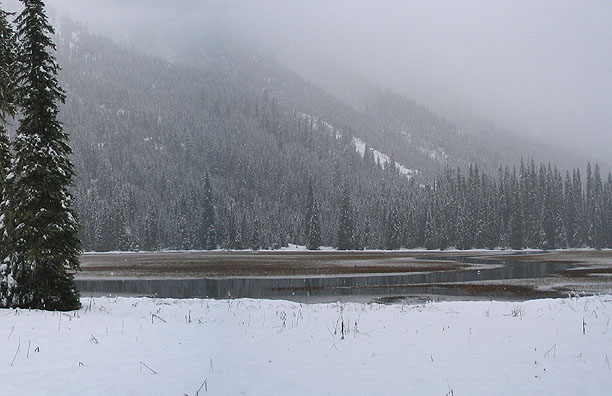
We stopped at Upper Hyas Lake and walked out into the golden lakeshore grass. The air was very still and the overcast had turned fuzzy and white and was sinking gently toward us, shrouding the peaks. We stood quietly beside the calm lake and watched the descending cloud. Soon a few lazy white flakes of snow swirled by, and then a few more.

The forested slopes above the lake faded slowly into white obscurity as the snow cloud grew thicker. Soon we couldn’t even see the far side of the lake and were surrounded by the whispering hiss of falling snowflakes.

As the snow thickened, we returned to the trail and continued the hike out. Walking along the lake shore, the ground in open areas was turning white. The snow grew heavier and the silence was filled with the faint hissing of colliding, falling, swirling, flakes. Millions of tiny ice-stars chipping and breaking.

We left the lake and walked into the thick forest. It had been autumn when we hiked in and now it was winter as we hiked out, the forest floor and trail covered in a couple of inches of smooth, silky snow. We found several fresh sets of coyote tracks and some deer tracks along the trail. The skeletal brush, fallen logs, boulders and drooping tree boughs were etched in white. I had the feeling that a blanket was being gently placed over the sleeping forest; protecting it through its long winter sleep.

By the time we reached the trailhead, there were over three inches of snow on the ground and it was still coming down. I was reluctant to leave. The storm was so quiet and peaceful it could barely be called a storm, even with the snow falling an inch an hour.

We did have to leave though, so we loaded our gear, got into the truck, closed the doors, turned up the heat and set the defroster to high, turned on the wipers to sweep away the snow and bumped off down the white road, encased in vehicle technology and insulated from the primal storm outside.

clevalleysnow

Getting Away to it All on the Olympic Coast

The trail from Lake Ozette to Cape Alava.

Boots make a hollow thumping sound on the rotting wooden planks that wind through the dark forest. Splashes of brilliant sunlight glow on ferns and mossy tree trunks.

A pilieated woodpecker hammers on a distant snag. Ahead a dull roar with booming sounds gets louder and ravens call. Then I hear gulls and the distinct explosions of surf on rocks. The light grows brighter and sky is visible straight ahead through the towering sitka spruce.

Cape Alava is close!

Anticipation grows and I emerge from the dark forest to a brilliant, wild coastline and a broad blue ocean and sky. Life is in motion everywhere. Gulls soar randomly over the rock-studded surf. Ducks fly in long lines or bob in the waves. Pelicans sweep by at water level, occasionally soaring up and then diving into the sea for fish. Sea lions toss their heads on a distant rocky outcrop. Seals bark. Sea otters ride the swells on their backs, cracking open shells. Deer walk by and graze on shoreline plants. Flies rise in clouds as crows hop among heaped wet piles of kelp. Seawater gurgles as the tide comes in.

The abundance of life, sound and movement is almost overwhelming. Time to sit on a bleached log for awhile and just look, listen and feel the active immensity all around. Time to not think for awhile. It’s pretty damn refreshing!

alavacoastscene1

Surf scoters
Surf scoters

Word Deployment

Have you noticed the plethora of military words and phrases entering common usage lately? It’s probably because of the unfortunate, ongoing wars and the large numbers of people being cycled through the armed services these days.

I do know that the Fire branch of the Forest Service has gone apeshit with that kind of language the last few years. It’s more of an odd blend of military and law enforcement/emergency services type lingo. I think it causes communication to be fubar.

One of the more popular military-type words inside and outside the Forest Service these days is “deployment”. Instead of something or someone being sent somewhere, they’re deployed. When you use something, you deploy it. As in, “I deployed some odor-eaters in my boots”, or “the telephone rang and I deployed it to my ear.” The FS talks of deploying the fire shelter in a fire emergency. A vehicle is deployed to go pick someone up. A toothpick is deployed to extract some broccoli from the teeth. On it goes.

A little bathroom humor...

I find this over-deployment of deployment to be deplorable. Where will it end?

Noisy Harleys and Summer Weekends

It’s the weekend again and although we were told that weekends were made for Michelob, it seems that around here weekends were made for Harley Davidson, and probably Bud Lite.

Roslyn has become a weekend riding destination for motorcycles, and judging by the low rumbling roar on the main drag, many of them seem to be Harleys. Very loud and disruptive to those of us who live along or near the main route through town. I’ve even been a couple of miles away, up on Roslyn Ridge, and heard them clearly as the moto-packs rumbled through town.

Impressing the Locals

“Loud pipes save lives” say the motorcycle noise advocates. I don’t understand this at all. Around here, loud pipes are just loud, and annoying, and disrespectful to the inhabitants. I know that motorcycles can be pretty quiet, so there’s no excuse for the intrusive noise that inundates our fair town on mellow summer days. It’s just a lot of showing off and attention getting and it’s too bad that this area has become a venue for that.

Riders could install quieter pipes, or ride quieter machines like the Honda Shadow, or even, gasp, the Gold Wing. I know that flies in the face of the reason that many people ride Harleys. It’s about image and being cool, and part of that is the sound.

Apparently, in a way I can’t fathom, being loud and obnoxious is equated with being cool. Probably the same mentality that believes a pickup truck covered in meadow mud is cool. So here are these people trying to be cool, but they’re just being obnoxious. Maybe that’s cool to them. Anyway, I wish they could find another place in which to act out their coolness fantasies, or get quieter bikes. That would be cool.

Tigers on the Loose in The Cascade Mountains!

[Note: This is a version of an article that went viral on the internet in 2016. It even earned a “hoax” designation from snopes.com. Many people believed it despite clear evidence that it was written in jest.]

Let this article be a warning to all. There are unkown unknowns out there!
Have the Forests of the Alpine Lakes Wilderness become the “Tiger Woods”?

An in-depth report by Investigative Reporter Cliff Gifford and the Paradox University Department of Cryptozoology (PUDOC).

CLE ELUM, WA (Paradox University News Wire)– Seamus O’Toole came to America to realize his dream, but in the dark forests of the wild North Cascades, he found instead a nightmare. His dream was to work and travel in the wilderness, experiencing the beauty and wonder of the wild places he’d longed for since he was a young lad on his parents’ mule ranch in Ireland. His nightmare was a near-fatal enounter with one of the largest predators that walks the earth. A predator that isn’t even supposed to be there.

For the last several years, reports and rumors have been coming from the forests of Washington State’s North Cascades; reports and rumors of sightings of tigers lurking in the once-benign mountains. Hikers and other recreationists as well as forestry workers have reported glimpses of large striped cats, droppings, tracks and even hair, mostly in the Alpine Lakes Wilderness. At least two missing hikers are unaccounted for and several horses and mules have been allegedly attacked and eaten by the tigers.

While government biologists have been hesitant to confirm the presence of tigers, sightings have increased and some biologists have admitted privately that they are convinced there is an unknown number of Siberian tigers living, breeding and feeding in the mountains of Washington State.

Independent wildlife biologist Sarah Sahara has no doubts and is outspoken on the issue. “People need to be warned that there’s a new player on the wilderness scene,” she said recently at a symposium at the Wild River Institute. “These large cats are right at home in our mountains and even grizzlies are afraid of them.”
When asked how the tigers appeared, Sahara said that over the years, she’s heard from several employees of the Federal Fish and Wildlife Service that two tigers were released near Snoqualmie Pass in late 2000.

“The original tigers were pets,” said Sahara, “purchased as young cubs by a couple from Bellevue.” When the tigers got older, according to the biologist, the couple could no longer control or care from them and began a long search for a new home. “Nobody could take them and the owners were informed that since no home could be found, the tigers had to be destoyed. They were taken into custody by federal wildlife agents and housed in a temporary holding facility pending a legal challenge from the owners.”

Their attempts to delay or stop the killing of the tigers ended when a federal judge ruled against them and okayed the destruction of the cats. “Here’s where the story gets real interesting,” said the biologist. “Three agents were given the unpleasent task of killing the tigers, but apparently couldn’t bring themselves to do it. Instead, they secretly agreed to falsify their report and release the tigers into the wild. They all thought that the tigers wouldn’t survive the winter and that at least they’d die free, so one November night in 2000, they drove the tigers to Snoqualmie Pass and released them in the parking lot at the Pacific Crest Trail trailhead.”

Sahara said that one witness claimed the men had to shoo the tigers into the woods with flares and shotgun blasts. “Apparently, at least one of the tigers had bonded with its keepers and wouldn’t leave.” The men were able to eventually drive off and leave the tigers to their fate.

Fish and Wildlife Service spokespersons declined to comment on this story, saying that it is under investigation now after a recent incident which removed almost all doubt as to the presence of the tigers in our forests.

Earlier this summer, a United States Forestry Service trail crew had a close encounter with a tiger on the Cle Elum Ranger District. It happened at a place called Lemah Crossing, near the popular Pete Lake area in the Alpine Lakes Wilderness Area. This was where Seamus O’Toole lived his nightmare.

“He was crossing Lemah Creek at that point,” said Sledge Foreman, one of the crew leaders, “and the rest of us were already across, encouraging him. Seamus sometimes can be a little slow, and he’s afraid of cold water, so we were all shouting and yelling at him to get his ass in high gear,” said the outspoken Foreman. “Suddenly, there’s loud splashing and motion off to the right and we see this huge tiger loping through the water towards Seamus. I couldn’t believe it. None of us could believe it. Here’s this big, mean lookin’ cat heading for poor Seamus, who’s grinning like an idiot as we’re shouting frantically and trying to warn him.”

What happened next can only be called a miracle, according to Seamus’ older brother Sean, who is also on the crew and was watching the terrible scene unfold from the banks of Lemah Creek. “Seamus is a good brother and friend,” said the Irishman, “but his potato patch is missing a few rows, if you know what I mean. He was kicked in the head by a mule years ago and was never the same, though some say it was an improvement. Anyway, here’s my brother about to get eaten by this massive, wicked, sodding beast and we’re all yelling our lungs out like maniacs. He finally heard the splashing behind him to his left, but turns instead to his right!”

Young Spudmuncher is almost lunch for a tiger.

This, said O’Toole, is what saved his brother’s life. “As Seamus turned, the beast leapt at him. My God, I’ve never seen anything like it! Such a huge creature it was and my brother looked so small, but God watches out for the special ones, you know, and now Seamus is living proof of that. As my brother turned and the tiger landed on his back, his pulaski handle [ a pulaski is a special axe-like tool used by Foresty Department personnel for chopping and digging] swung round and smashed into the cat’s ballocks.

“The cat, and I almost felt sorry for him, roared and dropped like a rock into the creek and curled up into a fetal position as Seamus ran splashing to the bank, laughing and crying at the same time. When he was safely ashore, we all started throwing stones at the cat, who dragged itself up and stumbled, soaking wet, into the brush as our rocks thunked on its evil hide.”

As for Seamus, according to crew medic Dusti Foreman, he had only a few minor scratches on his back and was working the next day. When asked why the crew didn’t hike out and report the incident immediately, crew leader Wedge Foreman, who is also a brother of Sledge and Dusti, said
simply, “We still had work to do and we weren’t
going to let some oversized house cat stop us from doing our job”. Dusti Foreman said,“Seamus was fine and the next day remembered only that he’d played with a big, beautiful cat and wondered where it was”.

Sarah Sahara and other biologists viewed the photo taken by a crew member and confirmed that it is a Siberian tiger. “I now think the story about the tiger release is true, as are some other reports, including one where a hiker saw a mother tiger and cubs playing in a meadow near Waptus Lake” said Sahara. “and that really scares me. The original tigers were siblings and they’ve apparently bred now.”

According to biologists, this inbreeding could produce offspring that are mentally and physically defective. What this could mean is that the new tigers may be less able to hunt effectively and more likely to hunt what’s easiest, which means people and their animals. Also, the mental state of the tigers may make them more aggressive and less able to restrain themselves. In a word, the offspring could be insane.

U.S.Forest Department officials declined comment pending the outcome of the Fish and Wildlife investigation, but one was heard to mutter, “I wish the crew had stuck with the talking points instead of talking out of turn.” When asked if some sort of warning should be posted, a Forestry Department source said only that “it’s a dangerous world out there and we can’t post warnings for everything”.

As for the trail crew members, most of them have no qualms about going out again. “We have no qualms about going out again,” said former tiger bait Seamus O’Toole. “I feel like I’ve been given a second leash on life and I don’t intend to let something like bad food in camp stop me.” Seamus’ brother Sean stated that, “I’ve got meself a great big shillelagh and I’ll thrash the **** out of that cat should he come near us again.” Other crew members aren’t so confident, but vow that their work is important enough to merit the risk.

Biologist Sahara is forming a team of scientists to further study the Siberian tigers and monitor the government studies. “In the meantime,” said the biologist, “I’d recommend that hikers and horse riders stay out of the Alpine Lakes until we can confirm how many tigers there are and where they hunt. Nobody wants to wind up as tiger scat on the trail.”

Aricle copyright 2009 by Jon R. Herman
Slothzax Will Slow the Hurry

Since I’ve been so lethargic about actually starting this blog, I thought it would be appropriate to address my dismay at the pace of our society these days. The constant demands, multi-tasking, rushing hither and thither, frantic rushing, speeding away our lives.

It’s driving me nuts! And I’ve been trying to combat it, but that’s a tough road. If only there was something that could help us all to slow the hell down. Some kind of magical pill or elixir. Something like…

SLOTHZAX!
Do you find yourself in a hurry ALL the time? Feel rushed and harassed by life’s demands? Are you scattered and distraught due to endless multi-tasking?

Maybe you’re ready for Slothzax. Made from the brain cells of genuine tree sloths, Slothzax will slow you the hell down, and in a hurry. Within days of starting Slothzax, you’ll find yourself decelerating to a slower pace of life. You’ll find yourself smelling those roses that you used to run over with the lawnmower. You’ll find time to smile at the hurry and bustle around you while you exist in a peaceful, stress-free bubble of slowness.

Late to work and hitting all the red lights? Not a problem with Slothzax. Didn’t get that report done on time? Who cares? What’s the freaking hurry anyways?

Slothzax. It’s for you. And if you order now, we’ll send you, absolutely free, a year’s subscription to Lethargy Journal.

*Caution: Slothzax may cause extreme irritation in others, may induce road rage events, cause job loss, and create family discord. Take according to directions. Have a slow day!

The preceding wishful thinking was formulated with the help of my friend Deb, who has her own share of Cartoonist’s Mind.